
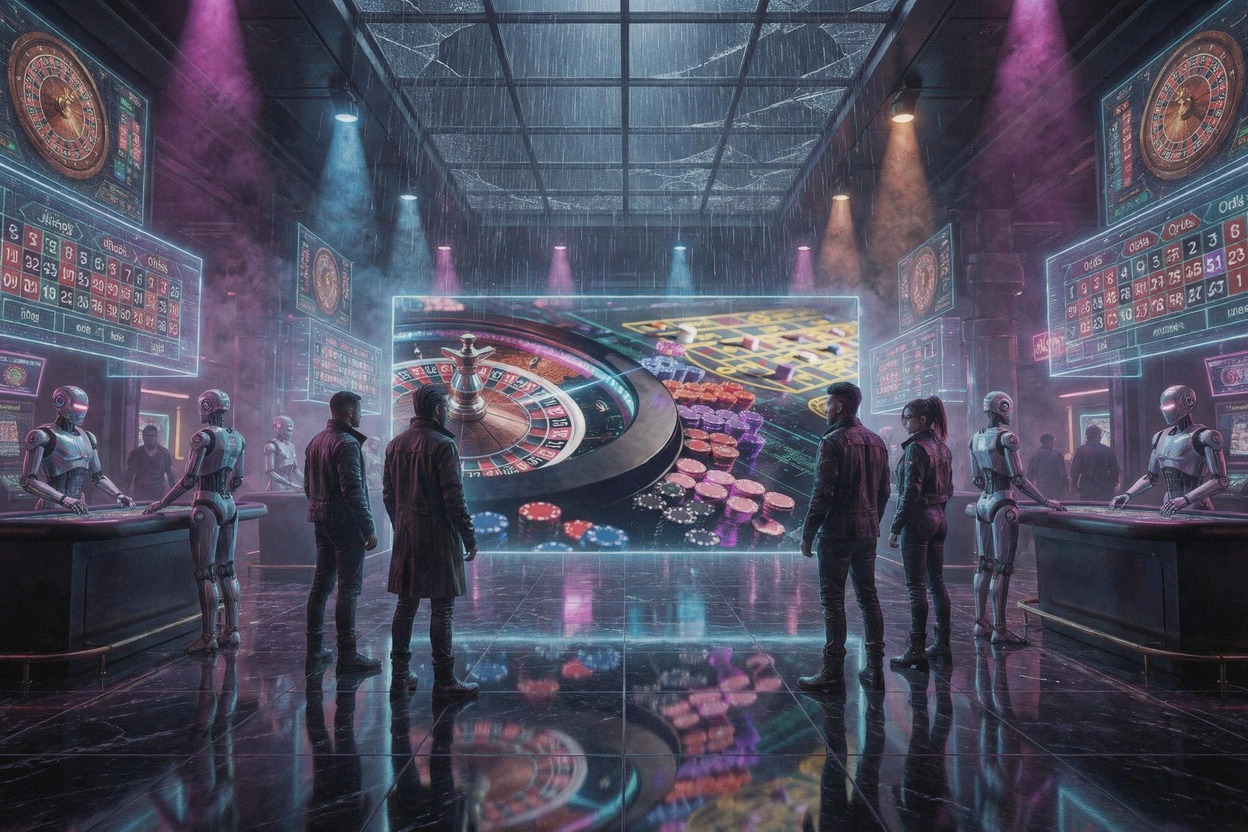
The Future of Poker: Live Dealers in the Metaverse
As we stand at the peak of 2026, the gambling industry has officially crossed the threshold into the spatial era. As a representative of this high-tech sector, I have witnessed the transition from the flat, 2D screens of the early 2020s to the fully immersive, volumetric environments we operate today. The most profound shift has occurred in how we perceive the game of poker. For decades, online poker was a game of statistics and cold clicks, stripped of the soul and the subtle human nuances that define the sport. However, the integration of the Metaverse has changed the landscape forever. When you join a poker live session in our virtual flagship casino today, you aren’t just looking at a video feed; you are sitting at a table made of digital atoms, feeling the weight of the chips in your hand and reading the micro-gestures of a dealer who is physically located thousands of miles away but stands inches from your avatar.
The Convergence of Physical Reality and Spatial Computing
In 2026, the term Metaverse is no longer a buzzword; it is the infrastructure of our daily gaming operations. The primary challenge we faced five years ago was the “uncanny valley” of digital interaction. Players wanted the convenience of home but the atmosphere of the Bellagio. Spatial computing has bridged that gap. By using high-fidelity headsets and haptic gloves, we have recreated the tactile sensation of a poker room.
When you sit at a Metaverse table, your brain is tricked into a state of “presence.” This is achieved through spatial audio, where the sound of the dealer shuffling the deck comes exactly from where their hands are positioned in 3D space. If a player to your left whispers a joke, you hear it in your left ear with the correct acoustic reverb for the room’s size. This level of immersion has transformed poker from a solitary digital task into a high-stakes social event.
Live Dealers as Avatars: The Human Element in 3D Space
The most revolutionary aspect of our 2026 poker suites is the “MoCap Dealer.” We no longer use simple video windows. Our dealers work in specialized motion-capture studios. Every time the dealer smiles, nods, or slides a card across the felt, their physical movements are mapped in real-time onto a highly detailed 3D avatar.
This technology allows for a level of interaction previously thought impossible. You can make eye contact with the dealer. You can see the slight hesitation in their hands as they handle a massive pot. This human element is the “ghost in the machine” that keeps the game grounded in reality. These dealers are trained not just in card mechanics, but in “spatial etiquette,” ensuring they move in a way that feels natural and non-intrusive in a VR environment.
Comparison: 2D Online Poker vs. Metaverse Poker 2026
| Feature | Traditional Online Poker (Legacy) | Metaverse Poker (2026) |
| Interaction | Text Chat / Emotes | Full Spatial Voice and Gestures |
| Visual Perspective | Fixed 2D / Top-down | Full 360-degree Volumetric 3D |
| Dealer Type | RNG or Small Video Box | Real-time MoCap Human Avatars |
| Physicality | Mouse Clicks / Taps | Hand Tracking and Haptic Feedback |
| Player Tells | Timing and Bet Sizing | Eye Tracking and Body Language |
The Technology Behind the 2026 Metaverse Table
To maintain a seamless poker experience in the Metaverse, we rely on a massive backend infrastructure. We are currently utilizing 6G connectivity and edge computing to reduce latency to under 10 milliseconds. In a game as sensitive as poker, any lag can ruin the psychological flow of a hand.
Our tables are powered by “Instance Syncing” technology. This ensures that every player at the table sees the exact same movement at the exact same microsecond. We use volumetric lighting to ensure that the shadows on the cards and the reflections on the chips are consistent for everyone. This isn’t just for aesthetics; it is for game integrity. If you can see a reflection in a chip, it must be the same reflection that every other player sees to maintain a fair playing field.
Tells and Body Language in a Virtual Environment
The greatest complaint about old-school online poker was the loss of the “live tell.” In the Metaverse, the tell has returned with a vengeance. Modern VR headsets in 2026 come equipped with internal cameras for eye tracking and mouth tracking.
- Eye Tracking: If your avatar is staring intently at your chips or looking away during a bluff, other players can see that. The hardware captures your pupil dilation and blink rate.
- Haptic Tremors: Through haptic gloves, the software can detect a slight tremble in a player’s hand as they reach for a large bet, translating that into the avatar’s movement.
- Voice Stress Analysis: While we protect player privacy, the natural cadence of your voice in spatial chat can give away more than you intend, just as it would at a physical table.
The Social Fabric of Metaverse Poker Rooms
In 2026, we have moved beyond the table. Our Metaverse poker rooms are part of larger “Resort Hubs.” Before a tournament, players meet in the virtual lounge. You can buy a digital drink with your winnings, discuss hands with your opponents, and even watch other games from the “rail” in a 3D spectator mode.
This social layer has led to the rise of “Poker Clubs” within the Metaverse. These are private, token-gated spaces where communities can host their own games with their own house rules. As an operator, we provide the “physics engine” and the “live dealer” as a service, while the community provides the atmosphere. It is a decentralized approach to the social side of gambling.
Blockchain and the Economy of Virtual Seats
The economy of our Metaverse poker rooms is entirely on-chain. In 2026, we use “Smart Seat” technology. When you sit at a table, your buy-in is locked into a smart contract. This eliminates any “payment friction” and ensures that as soon as you leave the table or win a hand, the funds are instantly settled in your digital wallet.
Furthermore, we have introduced “Collectible Seating.” Certain seats at our high-stakes tables are NFTs. Owning a seat at the “Golden Circle” table might give you a lower rake, access to exclusive dealers, or the ability to customize the visual theme of the table for all other players. This has created a secondary market for “poker real estate” within our digital casino.
Security and Anti-Cheating in the Spatial Era
With increased immersion comes the need for increased security. In the Metaverse, we have had to develop “Anti-Ghosting” AI. This software monitors the physical movement patterns of players to ensure that a “bot” isn’t driving the avatar. Every human has a unique “kinetic signature”-the specific way they move their head and hands.
Our AI cross-references this signature with the player’s history. If a player suddenly starts moving with the robotic precision of a script, the system flags them for a manual review by a digital pit boss. We also use “Visual Encryption” on the cards, ensuring that the digital data for a card’s value is only rendered at the moment a player “peels” the card in VR, making it impossible for screen-scraping software to read the deck.
Frequently Asked Questions
Do I need a high-end VR headset to play Metaverse poker?
While you can access our rooms in “Desktop Mode,” the full experience requires a spatial computing headset. By 2026, these devices have become as affordable as smartphones, and they are necessary if you want to use the hand-tracking and eye-tracking features that allow you to read other players’ tells.
Can I use my own custom avatar at the table?
Yes, we support most major interoperable avatar standards. However, for game integrity, we require that avatars maintain a “humanoid” silhouette and that the face remains uncovered to allow for eye and mouth tracking. You can wear digital skins and accessories, but the core geometry must be standardized.
How does the dealer know when it is my turn?
The Metaverse table uses “Spatial Proximity UI.” When it is your turn, your digital “chip tray” will glow slightly, and the dealer will physically turn their head and gesture toward you. You can make your move by physically sliding your chips forward or using a voice command.
Is Metaverse poker more expensive than regular online poker?
The rake is generally comparable to our standard live dealer tables. While the technology to run a Metaverse room is more expensive, the lack of physical overhead (real estate, electricity for a giant building) allows us to keep the costs down for the player.
Can I play for free in the Metaverse?
We offer “Social Lounges” where you can play with “Gold Coins” or play-money to get used to the controls and the spatial environment. This is a great way to practice the haptic “squeeze” of the cards before moving to our high-stakes real-money tables.
What happens if I lose my internet connection during a hand?
Our “Fail-Safe” AI takes over. If your headset disconnects, your avatar will go into a “Time Bank” mode. If you don’t reconnect within a certain timeframe, the AI will check or fold your hand according to a conservative strategy to protect your remaining chips until you return.
Can other players hear what is happening in my real-life room?
No. Our 2026 software uses “Background Noise Suppression.” It only picks up your voice and filters out ambient sounds like TVs, dogs, or other people in your house. You also have a physical “Mute” gesture (covering your avatar’s mouth) if you need to speak to someone in the real world.
How do I know the cards are shuffled fairly in VR?
The cards are shuffled by a certified Quantum Random Number Generator (QRNG). Even though you see a physical dealer shuffling, the order of the deck is determined by the QRNG and encrypted before the dealer even touches the digital deck. You can verify the “Proof of Fairness” after every session.
Can I record my sessions in the Metaverse?
Yes, we provide a “Cinematic Replay” feature. You can download a 360-degree file of your best hands, allowing you to re-watch the game from any angle, including your opponents’ perspectives (after the game is over), to analyze their tells and improve your strategy.
Is there a limit to how long I can stay in the Metaverse?
For responsible gaming reasons, our 2026 platform includes a “Reality Timer.” After 2 hours of continuous VR play, the system will suggest a 15-minute break. This helps prevent eye strain and ensures that players remain grounded and make rational betting decisions.
Conclusion
The transition of poker live into the Metaverse is the final piece of the puzzle for digital gambling. We have successfully recreated the “spirit of the game”-that intangible mix of psychology, physical presence, and social tension that was lost in the translation to 1080p screens. In 2026, sitting at a Metaverse table feels as real as sitting at a table in the heart of Las Vegas, but with the added benefits of global liquidity, instant blockchain settlements, and the ability to play from the comfort of your own home. As an industry, we have not just built a game; we have built a new dimension of human interaction where the cards are digital but the emotions are entirely real.
As we look further into the future, we anticipate even greater integration between the physical and digital worlds. The next step is likely “Neural-Link” interfaces that will allow for even more precise control over your virtual self. For now, the Metaverse represents the pinnacle of what is possible, offering a level of immersion that turns every hand into a cinematic event. Whether you are a casual player looking for a social night out or a professional shark hunting for tells in a volumetric space, the Metaverse is your new home. The dealer is waiting, the chips are ready, and the only question left is: can you keep your cool when the world around you is a digital masterpiece?